



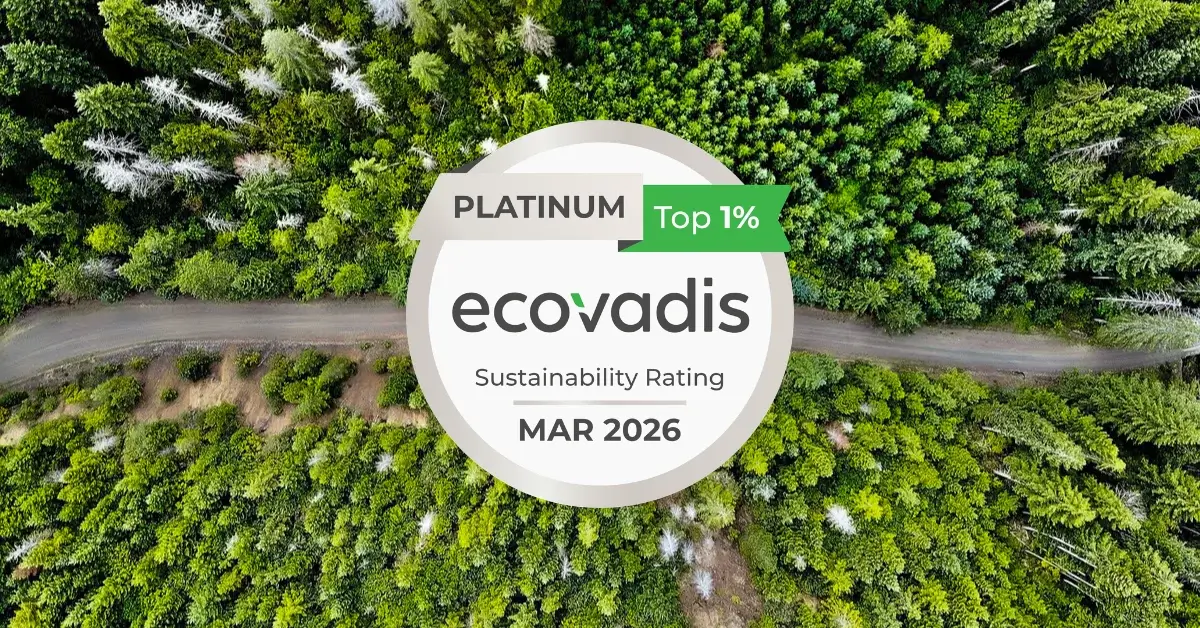


You’ve got policies in place. You run supplier audits. Your team is engaged, your initiatives are real and sustainability isn’t an afterthought, it’s built into how you operate. Then your EcoVadis results arrive – and the score doesn’t come close to reflecting any of it.
It’s a common frustration we hear from sustainability and procurement teams. And it’s almost never a sign that the business isn’t doing enough. It’s a sign that what the business is doing isn’t structured, evidenced or presented in the way EcoVadis needs to see it.
That gap – between genuine sustainability effort and a score that reflects it – is exactly where Greenheart works.
What EcoVadis actually measures
EcoVadis is a globally trusted provider of business sustainability ratings. It assesses companies across four themes:
- Environment
- Labour & Human Rights
- Ethics
- Sustainable Procurement
But the more important distinction is how it scores within those themes. EcoVadis evaluates across three layers:
- Policies: your documented intent
- Actions: how those policies are implemented in practice
- Results: measurable evidence of outcomes and improvement over time
Most of the scoring weight sits in actions and results, not policies. A well-written environmental policy earns limited credit if there is no evidence of what it is actually driving.
EcoVadis doesn’t measure intent. It measures how well your sustainability is structured, evidenced, and embedded.
This is where genuinely good companies lose ground. Their sustainability efforts are real, but they’re not organised in a way that a document-led assessment can see and score.
Why strong businesses still score poorly
In our experience, the gap between a business’s actual sustainability maturity and its EcoVadis score usually comes down to a handful of recurring issues:
- Evidence doesn’t meet requirements. Documents are present but undated, not company-specific or don’t clearly map to the question being asked.
- Activity isn’t centralised. Sustainability work is happening across departments, but nobody has pulled it together into a coherent, submittable picture.
- KPIs aren’t tracked or reported. Initiatives exist without measurable outcomes, which means the Results layer of the scoring stays empty.
- Responsibility is fragmented. No single owner means submissions are assembled under time pressure, with gaps nobody noticed until it was too late.
- Procurement isn’t treated as a sustainability function. The Sustainable Procurement theme is frequently under-evidenced, yet it carries significant weight in the overall score.
If your sustainability activity isn’t structured and evidenced properly, EcoVadis can’t see it.
EcoVadis is also more demanding than it first appears. The platform’s requirements are specific about document format, ownership and recency. Submitting the right content in the wrong format will cost you points.
EcoVadis and B Corp: different frameworks, same underlying challenge
EcoVadis and B Corp certification are often treated as entirely separate things – and in many ways they are. But at their core, they’re testing the same question:
How mature, embedded, and evidenced is your approach to sustainability across the business?
EcoVadis is faster, lighter, and more document-led. It is primarily driven by supply chain and procurement requirements – increasingly embedded by large corporates in their supplier standards, and gaining traction in the UK as public sector buyers raise expectations under the Procurement Act 2023.
B Corp is more comprehensive: it covers governance, stakeholder impact and cultural embedding, and carries a stronger brand and reputational dimension.
But both require clear policies. Both require evidence of operational implementation. Both demand measurable outcomes and cross-functional ownership. Companies that assume EcoVadis is simply the ‘easier’ version of B Corp often discover otherwise when they start working with the platform.
Where Greenheart’s B Corp experience becomes your advantage
Over the last 10 years, helping companies achieve and maintain B Corp certification has meant one thing above all else: translating complex, rigorous frameworks into structured, evidenced, practical action – and doing it in a way that actually changes how a business operates, not just what it submits.
That is exactly what EcoVadis requires.
| B Corp experience | EcoVadis application |
| Evidence mapping across impact areas | Structuring documentation to assessment requirements |
| Gap analysis against certification standards | Identifying score improvement opportunities by theme |
| Cross-functional team engagement | Coordinating inputs across departments and geographies |
| Impact measurement and KPI development | Providing credible results evidence |
| Continuous improvement roadmaps | Executing corrective action plans between cycles |
The transition from B Corp work to EcoVadis support has not been a stretch for us. It’s the same discipline, applied to a different format.
If you can build a business that meets B Corp standards, you can perform strongly in EcoVadis. The challenge is knowing how to translate that into the format EcoVadis expects.
What actually moves your EcoVadis score
Scores improve when three things are working together:
1. Quality of evidence
Documentation needs to be company-specific (not generic sector templates), clearly dated and explicitly linked to the question it is answering. Generic policies submitted without context are consistently underscored.
2. Coverage
EcoVadis assesses your approach across geographies and teams. Isolated initiatives will score lower than ones that are embedded across the whole organisation.
3. Proof of results
This is the area where businesses tend to leave the most points on the table. KPIs, reporting and demonstrated progress over time matter more than ambitious claims without data to back them up.
Policies get you started. Evidence of action and results is what moves your score.
From submission to strategy
One of the most useful shifts a business can make is to stop treating EcoVadis as a compliance task and start using it as a diagnostic tool.
The Corrective Action Plan EcoVadis provides after each cycle tells you, in precise detail, where your score is weak and why. The score breakdown by theme shows where effort will have the greatest impact. Used properly, this is a roadmap both for your next submission and for the operational improvements that make the business genuinely stronger.
Businesses that use EcoVadis this way – as a structured lens on sustainability maturity – consistently improve across cycles. Those that treat it as a one-off submission exercise tend to plateau.
Where Greenheart fits
We support businesses preparing for EcoVadis assessment by doing four things:
- Turning ambiguous requirements into clear actions. EcoVadis can be genuinely difficult to interpret. We translate what’s being asked into practical steps.
- Identifying where effort will actually impact your score. Not all improvements are equal. We focus attention on the areas with the most scoring leverage.
- Supporting teams to build credible, usable evidence. We help you structure and document what you’re already doing, rather than creating the appearance of activity that isn’t there.
- Embedding improvements into the business. So that your next cycle starts from a higher baseline, and EcoVadis becomes a genuine reflection of how you operate.
We don’t just help you submit. We help you build something real behind the score.
A score worth having
EcoVadis, like B Corp and the wave of sustainability reporting requirements now arriving for businesses of all sizes, is part of a wider shift. The direction of travel is clear: sustainability as a set of claims is giving way to sustainability as something structured, evidenced and lived across the business.
Handled well, that’s not a burden. It builds credibility with customers, buyers and investors. It strengthens operational resilience. It creates a foundation for long-term value that a compliance-first approach simply can’t replicate.
Sustainability alone is not enough for strong Ecovadis performance. But with the right structure behind it, it becomes something that compounds over time.
Preparing for your next EcoVadis assessment?
Let’s make sure your score reflects the work you’re already doing and where you want to go next. Let’s chat.
